DataViewer overview
DataViewer is the main umIT application. In one window it imports recordings, displays image time series and their temporal signals, runs processing pipelines, and creates and measures regions of interest (ROIs). Everything else in umIT is reached from it.
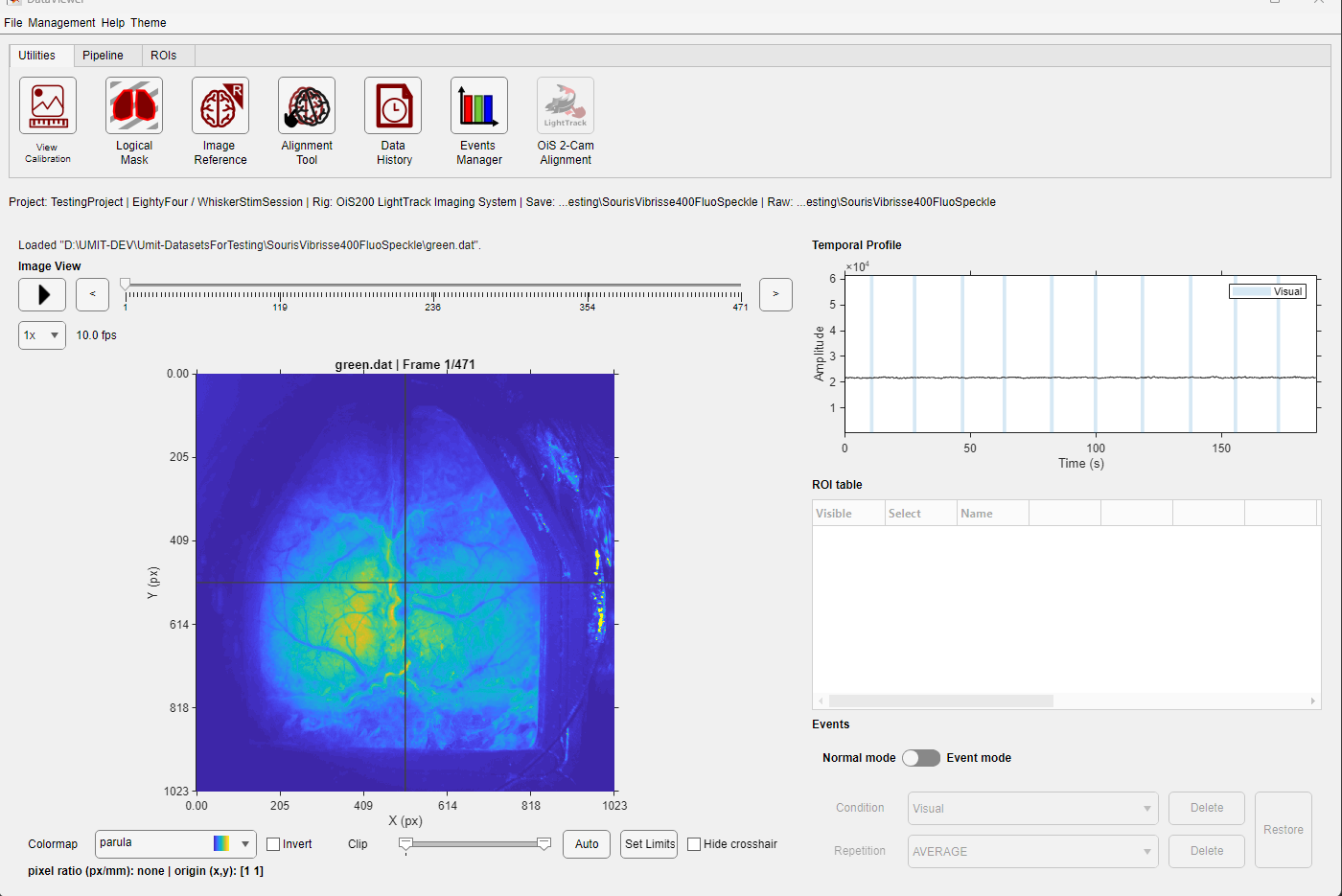
DataViewer with a demonstration recording. The context line below the toolbar shows the Save Folder of the loaded data.
Launch
DataViewer;
DataViewer("C:\data\session\green.dat");
DataViewer("FilePath","C:\data\session\result.umt");
A typical session
- Import the raw data. File > Import > from .bin (LabeoTech systems) or from .tif creates one .dat file per imaging channel in a Save Folder, with the acquisition information in AcqInfos.mat. See the data import tutorial, ImagesClassification and importFromTif.
- Explore the raw data. Open a channel with File > Open, move through the frames or play them as a movie, adjust the display, and click a pixel to see its signal through time. Events, when present, let you switch to an event-aligned view. See Data loading and basic exploration, Image visualization and Temporal visualization.
- Process the data. On the Pipeline tab, Pipeline Manager chains analysis functions, for example filtering, normalization (ΔF/F or ΔR/R), hemodynamic correction or hemoglobin computation, starting from the open file. Results come back to the viewer as temporary files until you save them. See Processing and export and Pipeline Manager.
- Create ROIs and extract signals. On the ROIs tab, draw regions, create them by threshold or from the Allen atlas, and export their measurements and time courses. See ROI management.
- Save what you need. Display settings are not saved; processed results and ROIs are saved only when you ask (see below).
The User interface page describes every menu, tab and control.
Supported files
| Source | Required information | Behavior |
|---|---|---|
| .dat | The file's own header | Stores one image channel or result. Its header describes its axes, sizes, data type and frame rate. |
| Image-kind .umt | A compatible image entry | Stores results whose dimensions or origin do not fit a .dat file, such as one map per condition or data combined across recordings. The file carries the metadata needed to describe each entry. |
This two-file framework keeps large, equally sized continuous channels simple while allowing smaller processed results—such as amplitude maps or event averages—to describe their own dimensions and labels.
Context line
The line below the toolbar summarizes the loaded Save Folder, for example Project: Not assigned | Rig: Rig A | Align: not aligned | Save: … | Raw: …. Hover over it for details (binding state, rig ledger state, alignment reference). Binding problems found when the data are loaded are also reported in the status line above the image.
| Part | Values |
|---|---|
| Project | The project, subject and session the folder is bound to, or Not assigned. See Project and session integration. |
| Rig | The folder's rig, read from its rig ledger (see Folder rig). |
| Align | aligned once an image alignment was applied to the folder, otherwise not aligned. The tooltip names the reference and when it was applied. See Image Alignment Tool. |
| Save / Raw | The Save Folder and the Raw Folder recorded for the data (Missing when unknown). |
Projects and rigs
Two optional resources, reached from the Management menu, support larger studies and specific analyses. Neither is needed to view, process or measure data.
- Projects organize recordings by subject and session. Use a project when several recordings of the same animals must be compared over time, for example to align every session of a subject to one shared reference image. See Project and session integration.
- Rigs describe the imaging hardware (cameras, illumination spectra, dual-camera calibration). A Save Folder needs a rig only for analyses that depend on the optics, such as HemoCompute, and for dual-camera imports. See Folder rig and Rigs and Optical Library.
What is kept and what is saved
DataViewer is designed for basic exploration, so you do not need to save every display change. Frame position, colormap, clipping, crosshair position, and most previews last only for the current session. The app saves only metadata that must remain associated with the Save Folder, such as confirmed image calibration, coordinate origin, logical mask, Raw Folder location, and ignored event selections.
Processed images and newly created ROIs are not saved automatically. Use the relevant save or export command when you need to keep them. See Processing and export and Save Folder metadata files.